
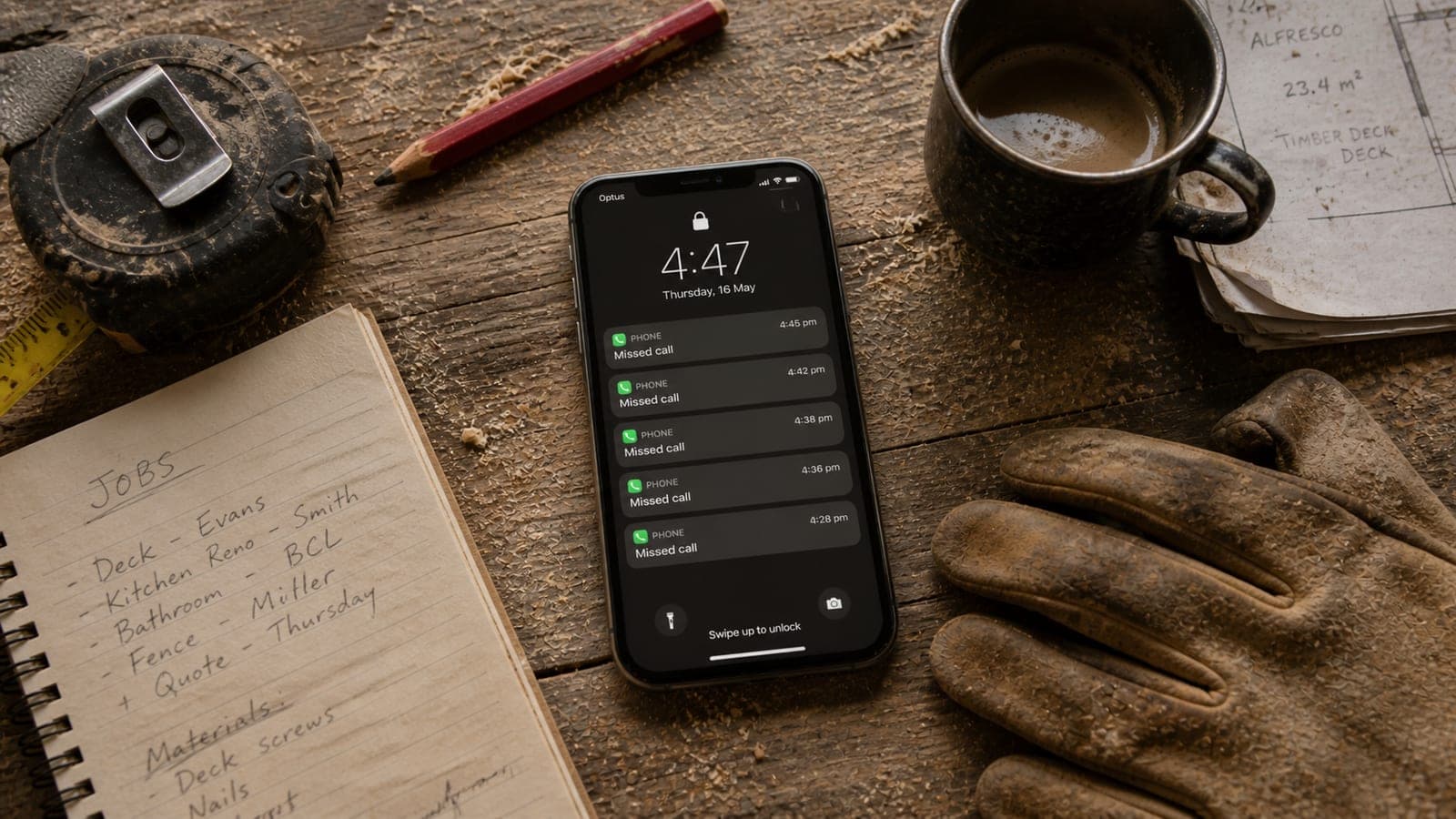
If you’re running a service business in Australia, your phone is your shopfront. Every call that hits voicemail isn’t just a missed conversation. It’s a customer walking past your front door and into your competitor’s.
Talking to service-business owners across Brisbane, the Gold Coast, and surrounds (trades, real estate, dealerships, gym owners), the pattern shows up consistently: owners underestimate how many calls they’re missing, and underestimate what each missed call is actually worth.
Here’s the maths and the realistic fix.
The data: 14 missed calls a week
When owners actually look at their phone log, the number is usually higher than they thought. Typically 12–18 missed calls a week is what owners report when they actually count, across plumbing, real estate, and other service trades. We use 14 as a working number. That’s not 14 missed prospects, many callers leave voicemail or call back. But around half don’t try again. They just call the next business on the Google Maps list.
So a baseline of 5–8 lost prospects per week is realistic. Multiply that by 52 weeks and you’re looking at 260–400 lost opportunities a year before you’ve even left the office.
The maths: what's a missed call actually worth?
Let's run two real-world examples.
The plumber. Let’s say a $400 average job value and a generous 50% conversion when you actually answer. So every 2 missed calls costs roughly one job. $400 in revenue. At 5 lost prospects a week, that’s $1,000 a week, or $52,000 a year walking out the door.
The real estate agent. Average commission per sale on a mid-market property: roughly $12,000. Conversion from enquiry to listing isn’t 50%. More like 5%. But the value per converted call is so much higher that even one lost listing every two months works out to $72,000 a year gone.
These aren’t crazy numbers. They’re what shows up when you actually run the maths against the call volume most of these businesses already have.
Why "I'll get back to them later" doesn't work
A few reasons:
-
Call urgency decays fast. A customer ringing about a burst pipe at 7pm isn’t going to wait until you check voicemail tomorrow. They’re calling someone else within 90 seconds. Industry research consistently shows that contacting a lead within 5 minutes dramatically outperforms waiting, the longer the gap, the lower the conversion.
-
Voicemail conversion is brutal. In practice, voicemails have a low reconnect rate. By the time you call back, the customer has often already booked someone else. Plenty never leave a message in the first place.
-
You can't predict which calls matter. The $40,000 fence job and the time-waster both hit voicemail with the same beep. You don't get to triage what you can't hear.
What actually fixes it (and what doesn't)
A few things business owners try, in order from worst to best:
- “I’ll just check voicemail more often.” Doesn’t work. The bottleneck isn’t your discipline; it’s that you’re on the tools.
- “I’ll hire a receptionist.” Useful, but expensive. Typically $25–35k a year for part-time hours and $55k+ for a full-timer once you load super and overheads (rough Seek/Indeed averages for an admin/receptionist role in Brisbane). Only covers business hours, and doesn’t help when they’re on lunch or away.
- “I’ll forward calls to my mobile.” Means you can answer them. But you’re still the bottleneck, and you can’t take a call up a ladder.
- An always-on AI receptionist. Answers every call within 0.8 seconds, qualifies the lead, books the job into your calendar, and texts you a summary. Works at 9pm on a Sunday. Doesn't take lunch breaks.
That last option is what we build at SGS. An AI receptionist that handles the calls you’d otherwise miss, plain and simple. We’re not anti-human-receptionist. We just notice that the bulk of the calls a receptionist actually handles (booking, quoting, qualifying, redirecting urgent jobs) are routine, and a properly-trained AI handles them faster, cheaper, and around the clock.
How do I stop missing leads in my service business?
The honest answer in one paragraph: build a system that contacts every new lead within seconds, not minutes, and stops relying on the phone being in your hand at the right moment. For most Australian service businesses, that means an instant SMS auto-reply on every missed call, an AI voice agent that picks up calls you'd otherwise let go to voicemail, and a clean handover into your CRM so nothing falls through the cracks. The four levers, ranked by ROI for service trades:
- Speed to Lead automation. An instant SMS to every missed call within 30 seconds, with a one-tap reply option for the customer. Keeps the conversation alive while the lead is still hot. (More on Speed to Lead in our dedicated post.)
- AI receptionist. Answers every call live, qualifies the caller, books the job, and texts you a summary. Stops the leak at the source.
- Quote follow-up automation. Three nudges over seven days so quotes don't go cold while you're on the tools.
- Lead nurture sequence. A 9-day SMS plus email follow-up for leads that don't book straight away. Stops on reply.
You don't need all four to see results. Speed to Lead alone typically rescues 30–50% of the leads a service business was previously losing. The other three stack on top.
Quick test you can run this week
Before you do anything, run this 7-day audit on your own business:
- Count the missed calls in your phone log for the last 7 days. Don't underestimate. Count voicemails too.
- Multiply by your average job value × your typical phone-to-job conversion rate. Don't be precise; rough is fine.
- Halve it (because some callers do try again).
That number is roughly what missed calls are costing you per week. If it's more than $200, the maths on fixing it is genuinely overwhelming.
What to do next
If you want to see what an always-on AI receptionist sounds like before committing to anything: hear the live demo. 60 seconds, no card, no signup. Just hear what your customers would hear.
Or if you'd rather have a real conversation about whether it'd actually work for your business: book a 30-minute discovery call. We'll map your call flow, work out what you're missing, and tell you straight whether this is the right fix for your operation.