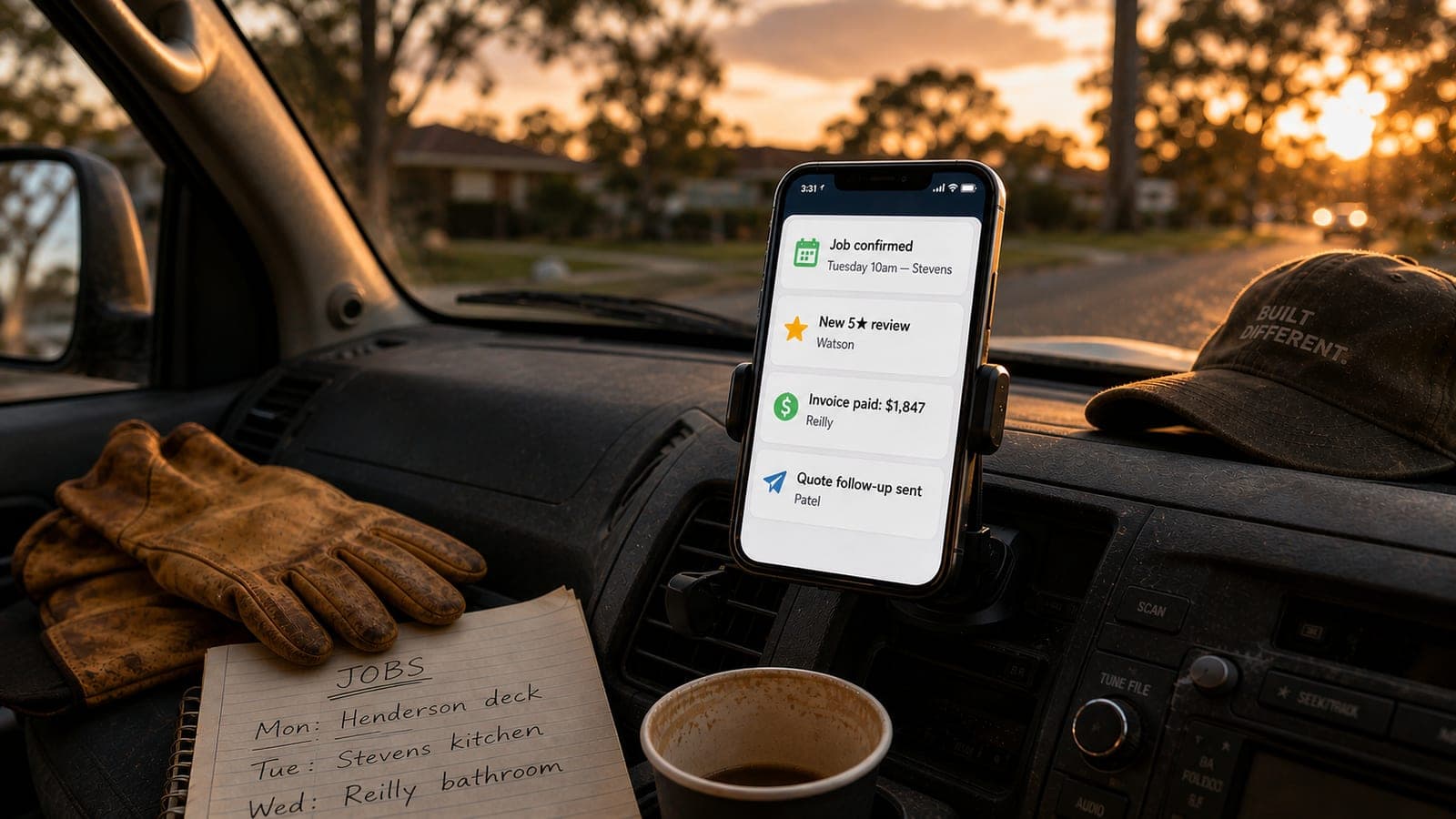

What does Speed to Lead mean, and why does it matter?
Speed to Lead is the discipline of contacting a new lead in seconds, not minutes. It's measured from the moment a customer rings your business, fills out a contact form, or sends a DM, until the moment they hear back from you. The shorter the gap, the higher the chance they actually book.
For Australian trade and service businesses, Speed to Lead matters more than it does in almost any other industry. The owner is on the tools all day. The phone is in another room. Customers shopping a tradie or a service provider are typically ringing more than one business at the same time. Whoever picks up first usually books the job.
That's the entire premise. The rest of this post breaks down what it looks like done well, what most operators get wrong, and how to fix it without stitching together a half-dozen SaaS tools.
Why this is brutal for tradies and service operators
Most office-based businesses have someone at a desk who can reply to enquiries within a few minutes during business hours. Even without automation, that's achievable on a normal day.
Tradies and service operators don't have that. The owner is:
- Under a sink with their phone on the dashboard of the ute
- On a roof with both hands occupied
- In a customer's home where pulling out a phone mid-quote is unprofessional
- At lunch, on a break, or asleep when the call comes in at 7pm or on a Sunday
So the operators most likely to benefit from Speed to Lead are the ones least equipped to do it manually. For a typical owner who's on the tools most of the day, the window where the phone is actually in their hand is small. The rest of inbound calls and form fills hit voicemail, sit in the inbox, or get forgotten until evening.
By the time the owner finally rings back at 7pm, the customer has often already booked someone else.
What Speed to Lead actually looks like, done right
Here's the sequence we wire up for service businesses we work with:
At 11:42am, a customer rings. Owner doesn't answer, they're on a job.
At 11:42am +5 seconds, the customer's phone buzzes with an SMS:
"Hi! Sorry we missed your call. We've got you down and we'll ring back within the hour. Anything urgent? Reply here and we'll see it straight away."
Same moment, the lead lands in the CRM tagged "Phone · Tuesday 11:42am". The owner gets a push notification on their phone.
If it's a real prospect (vs. a wrong number or sales call), the conversation has already started. The customer has been acknowledged, the business has shown it's responsive, and the customer is now psychologically committed to this provider instead of dialling the next one on the list.
If the customer replies "yes urgent", the SMS auto-detects that, escalates the lead to top of the owner's queue, and pushes an alert through. The owner can then ring back within minutes, knowing it's worth interrupting the job for.
If the customer doesn't reply, the next-step automation kicks in: a callback reminder for the owner, a second SMS at the four-hour mark if no contact has happened, and the lead joins a nurture sequence so it doesn't die on a Post-it note.
That's the whole flow. The customer feels handled. The owner feels in control. The lead doesn't die.
What most operators get wrong
Speed to Lead sounds simple. The implementations we look at when prospects bring them to us are often half-built. Three common mistakes:
1. Generic SMS templates that smell like a SaaS tool. "Thanks for contacting us! Someone will be in touch within 24 hours." Customers can tell this is automated. It feels like the start of a no-reply email chain. The customer disengages mentally. A properly written SMS sounds like a real person typed it from their ute. Tone matters more than speed at this stage.
2. No CRM integration. The SMS goes out, the customer replies, and the reply lands in a phone the owner doesn't check. Or it lands in a CRM the owner doesn't actually use. The whole point of Speed to Lead is closing the loop, by automating the first touch so the human can land the second touch when it counts. If the loop never closes, the lead still dies.
3. No urgent-vs-not branching. All leads are treated the same. The customer with a burst pipe at 7pm gets the same auto-reply as the customer asking for a quote on a deck rebuild next month. The owner can't triage what they can't hear. A proper Speed to Lead system reads the customer's reply (or the qualifying question they answered on the form), flags genuinely urgent leads, and escalates them immediately to the owner's mobile.
Most of the "Speed to Lead" setups that get cobbled together with off-the-shelf SMS providers fall over on one or more of these. The reason this works as a productised automation is the integration depth, not the SMS itself.
How to build it without a stack overhaul
You don't need to throw out your existing tools. Speed to Lead runs alongside ServiceM8, simPRO, Tradify, AroFlo, Xero, and most other AU service-business software. The integration usually goes:
- Trigger: missed call or web form submission (or both)
- First SMS: instant, tuned to your brand voice
- CRM write: lead created with phone number, tag, source, timestamp
- Owner alert: push notification on the owner's mobile
- Branching: customer reply read by AI, urgent vs. not, escalation rules fire
- Fallback: nurture sequence engages if no human contact within four hours
The whole stack goes live in about two weeks for a typical service business. Most of the time is spent tuning the SMS copy, mapping the urgent-vs-not branching rules, and integrating with whatever CRM and accounting software the business already runs. The technical wiring is the small part.
Where to start if you're not ready to wire it up yet
If you want to test whether Speed to Lead would move the needle for your business before you commit to anything, do this:
- For one week, log every inbound call you miss. Note the time and the source.
- For each missed call, write down whether you eventually got back to that customer and whether they booked the job.
- At the end of the week, count the leads that died because contact was too slow.
In our experience, that share is often substantial. Multiply by your average job value and you've got the Speed to Lead opportunity in dollars, specific to your business.
If that number is anything north of $500 a week, the maths on fixing it is overwhelming.
The short answer
If your business depends on inbound enquiries and the owner is on the tools, Speed to Lead is one of the highest-ROI automations you can put in place. Faster than chasing new ads, easier than hiring, and it stacks well with the rest of your operations.
At Summit Growth Systems we build the full Speed to Lead flow as part of our automation pack. Instant SMS, CRM integration, urgent-lead branching, owner alerts, all tuned to your business. Live in 14 days.
If you want to hear what the receptionist side of it sounds like first: hear the demo. If you want to talk through your specific call flow and what's leaking: book a 30-minute discovery call.