Most tradies we talk to are doing the work of three people. On the tools all day, on the phone between jobs, chasing quotes in the evening, chasing late invoices on the weekend, asking happy customers to leave a review somewhere along the way. And somehow trying to grow the business in whatever’s left.
The problem isn’t that you’re not working hard enough. It’s that the work that actually pays (being on the tools) is constantly being interrupted by the work that doesn’t.
Good automation isn’t about replacing your team. It’s about doing the repetitive stuff in the background so people don’t have to. The right five workflows quietly make sure no leads, jobs, or invoices slip through the cracks. And give you back a chunk of your week to either work on the business or, you know, see your kids before bedtime.
Here are the five we’d set up first for any Australian trade business in 2026, ranked by impact in a typical week.
1. Speed to Lead
The instant text-back that wins jobs before the competition picks up.
Industry research consistently shows that contacting a lead within 5 minutes dramatically outperforms waiting. The longer the gap, the lower the conversion. For tradies, that’s brutal, because by definition you’re often up a ladder when leads come in.
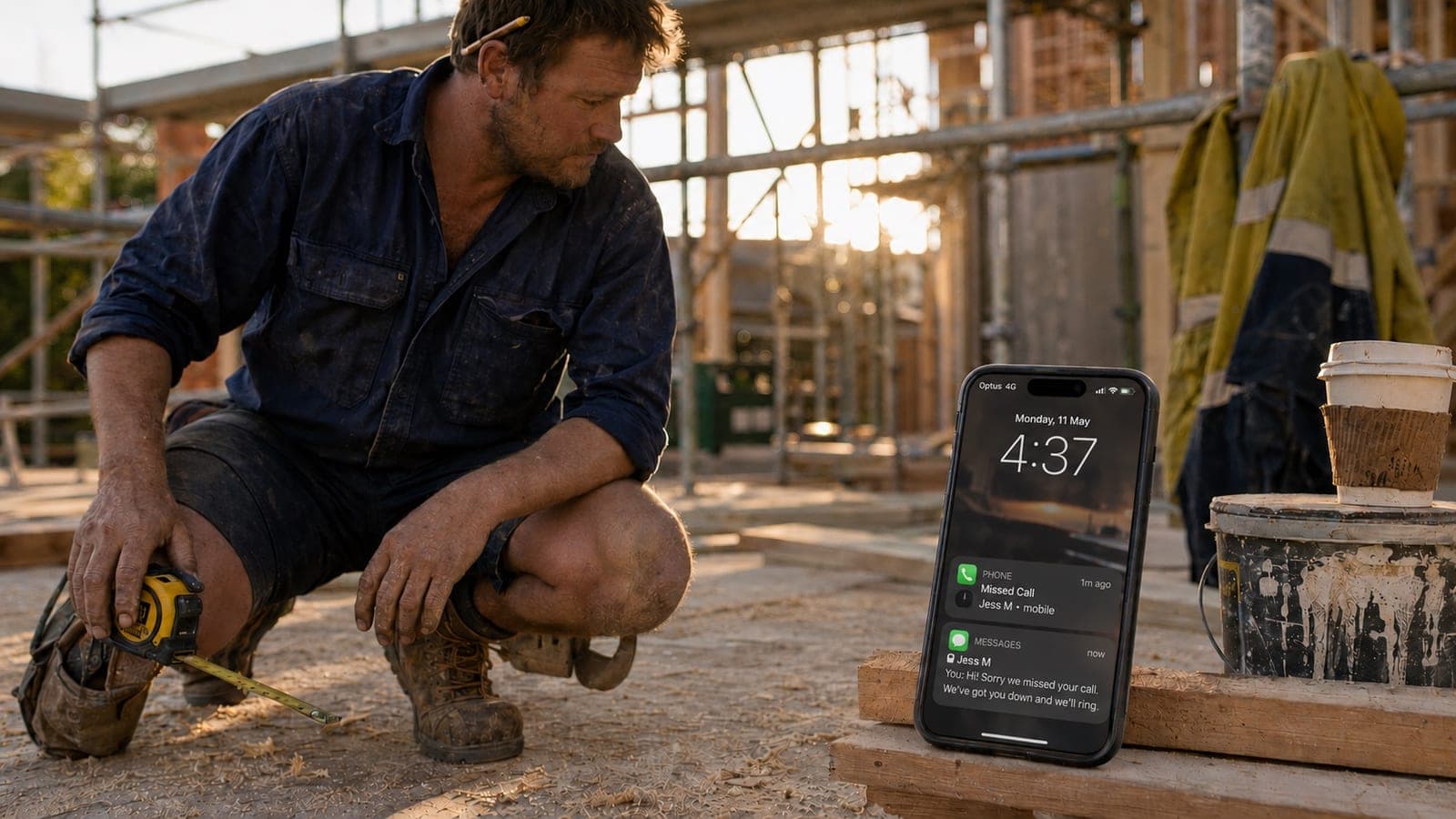
Speed to Lead means: the moment someone misses calling you, or fills out the contact form on your website, they get an instant SMS reply within seconds. The lead lands in your CRM with the right tag (e.g. “After-hours · Plumbing”), and you get a heads-up.
What it looks like in practice:
- 11:42am. Customer rings, you don’t answer (you’re under a sink)
- 11:42am. They get an SMS: “Hi! Sorry we missed your call. We’ve got you down, we’ll ring you back within the hour. Anything urgent? Reply here.”
- 11:42am. The lead lands in your CRM, owner gets a push notification on the mobile
Why it matters: a reply within 60 seconds tells the customer “this business is on it”. And that’s usually enough to stop them ringing the next plumber on the Google Maps list.
What makes it work: the timing, the tone of the SMS, and the CRM integration. Generic templates feel generic. And customers can tell. We build it tuned to your brand voice and connected to the tools you already use.
2. Job Confirmation + “Tech On the Way”
The polish move that makes a one-person operation feel like a 20-person team.
The single most undervalued automation in trades. Almost every customer no-show happens because they forgot, didn’t know who was coming, or didn’t know exactly when.
This one fixes all three:
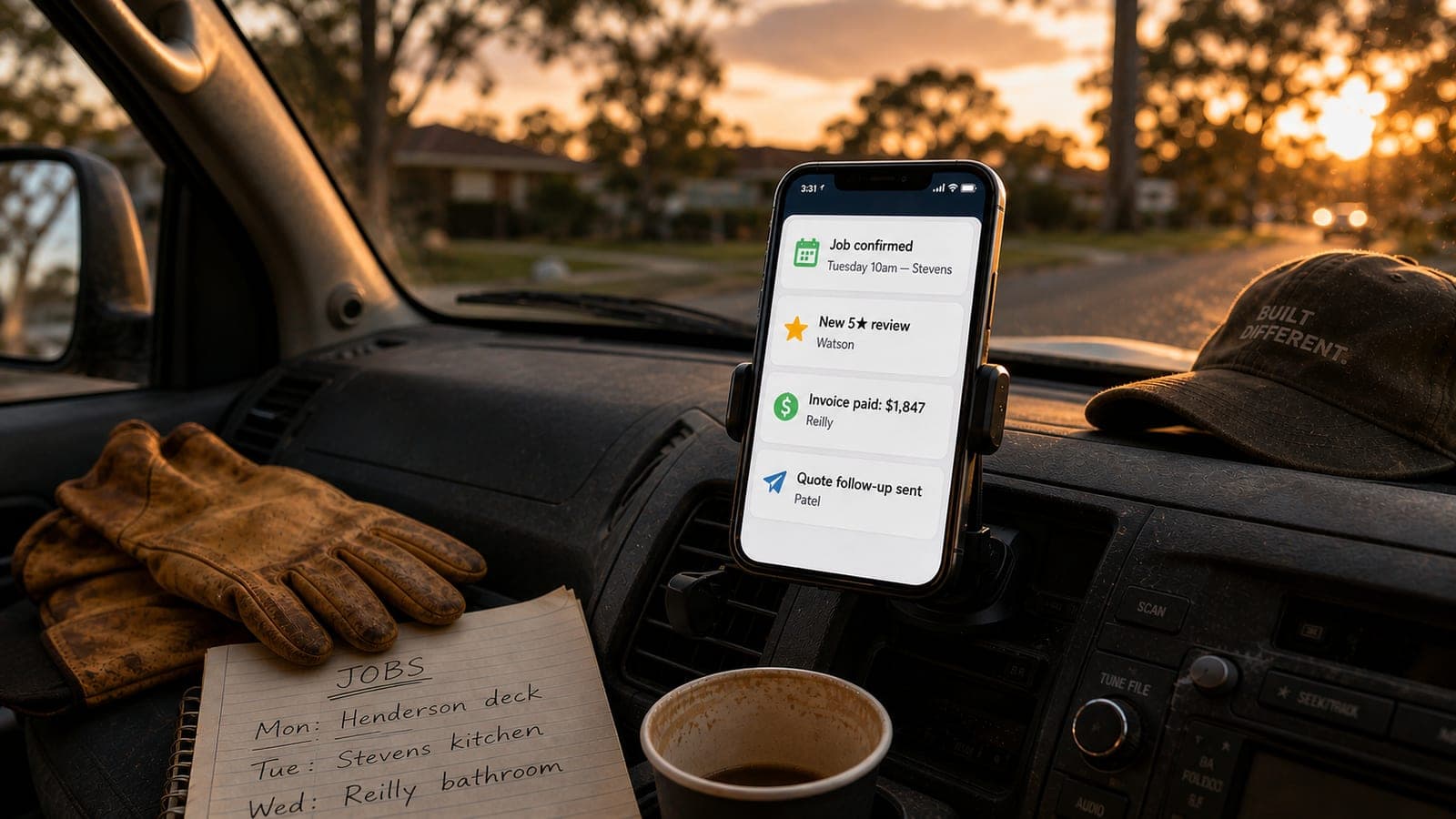
- Booking confirmation SMS the moment the job is locked in: “You’re booked for Tuesday 14th at 10am. Sam from [Business] is your tech. Reply ‘change’ if anything comes up.”
- 24-hour reminder
- 1 hour before the job, the tech taps a link on their phone. Customer instantly gets “Sam is on his way, ETA 10:00am.”
- If the tech forgets to tap within an hour of the appointment, the owner gets pinged so they can chase it up
Why it matters: customers feel taken care of without you doing anything extra. Trust gets built before the tech even arrives. And you stop bleeding revenue from no-shows you didn’t see coming.
The “tech on the way” piece is the polish move. Big trade businesses pay heavy software fees for this exact flow as part of a $10k+ stack. You can run the same flow for a fraction of the cost once it’s wired up.
What makes it work: the polished tech-on-the-way trigger is what closes the loop. Basic booking confirmations are common, but the “Sam is on his way. ETA 10:00am” SMS that fires off a one-tap action from the tech’s phone is rarely set up properly. We build the full version into the automation pack.
3. Quote Follow-Up
Quotes don’t go cold on your watch anymore.
Most tradies send a quote and then wait. The customer goes quiet for 3-7 days. You start to feel awkward chasing it. Eventually the quote just dies. And you’ll never know whether they went elsewhere or just forgot.
Here’s the thing: most quotes don’t go cold because the customer doesn’t want the work. They go cold because life got in the way and your quote slipped down their priority list. A friendly nudge at the right time brings it back to the top.
Quote Follow-Up automation:
- Day 2 after the quote goes out. Light touch: “Just checking in, any questions about the quote?”
- Day 5. Stronger: “Still keen, or have you gone in another direction? Either way, no stress.”
- Day 7. Final ask with a clear out: “Last check, are we still in the running? If not, no worries, I just want to update our schedule.”
- When the customer replies, AI reads the response and routes it: accepted → books the job, declined → marks lost, unclear → hands to you
Why it matters: you stop being the awkward chaser. Quotes that would otherwise sit cold get nudged at the right time. And you get clean data on what’s actually closing. So you can quote more accurately next time.
What makes it work: the AI step that reads the customer’s reply and routes accordingly is what stops you having to babysit the follow-up sequence. Otherwise you’re manually checking every reply and triaging it yourself. Which defeats the point. We include the full sequence in the standard automation pack.
4. Customer Satisfaction + Review Gate
The automation that protects your Google reviews.
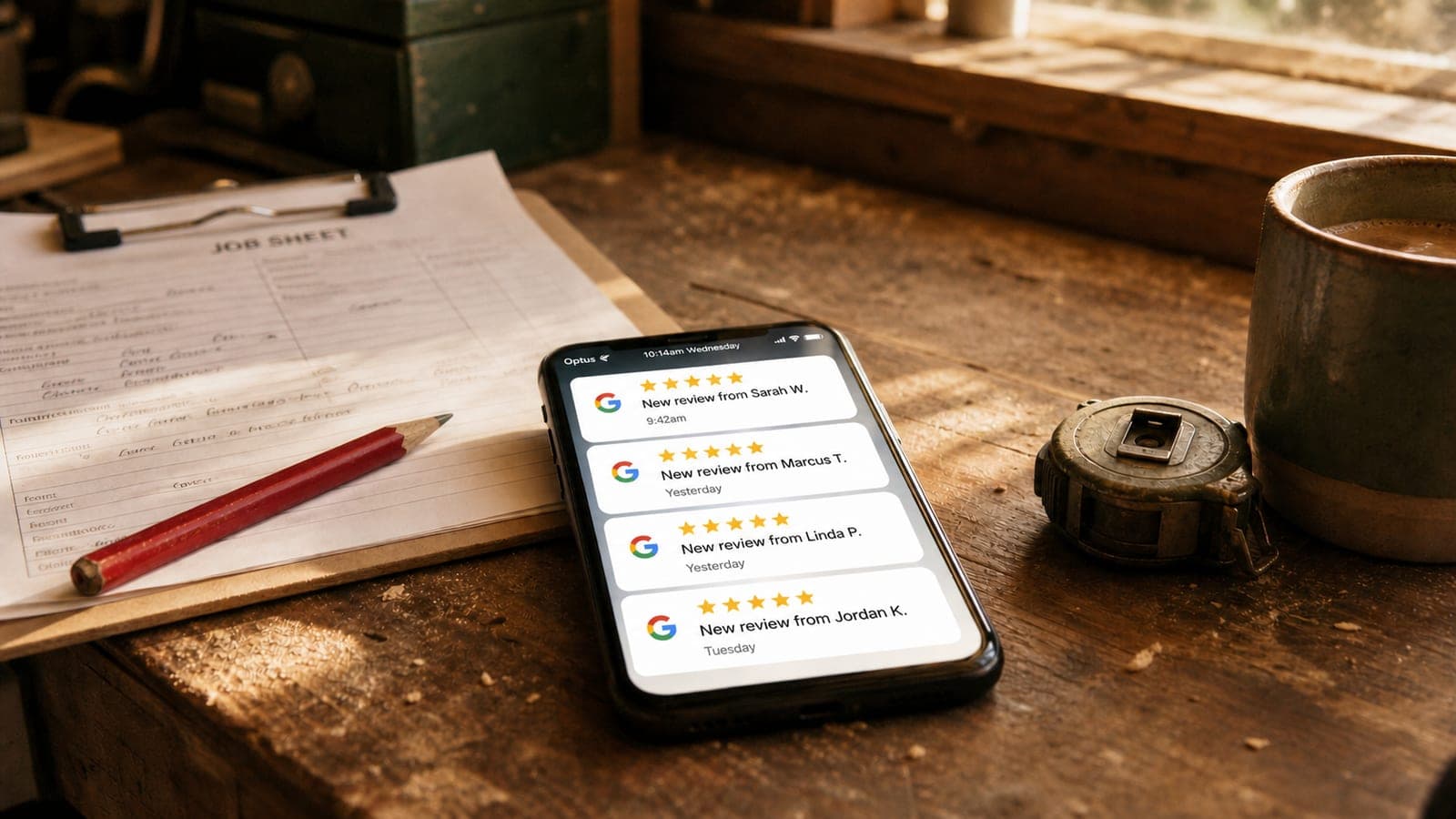
Google reviews are the single biggest factor in whether new customers pick you over the next tradie on the list. But most operators do one of two things:
- Never ask, and miss easy 5-stars they’d have got
- Ask everyone, and occasionally cop a public 1-star they could’ve fixed privately
The Review Gate fixes this with one extra step.
After every completed job, the customer gets a quick SMS: “How would you rate the job, 1-5?”
- Score 4 or 5 → they get the Google review link, sent straight to your profile
- Score 1, 2, or 3 → they do not get the public review link. Instead, you get an immediate alert. You ring them, fix the issue, often turn them into a five before it ever becomes public.
Why it matters: you grow your review count consistently without rolling the dice on every single customer. The customer who’d have given a 3 because their mate was rude on the phone is the exact customer you want to hear from privately. Not see on your Google profile.
What makes it work: the score-based branching, the owner alerts on low scores, and the integration with your Google Business Profile so the review link goes to the right place. We include it in the automation pack because too many trade businesses are leaving easy reviews on the table without it.
5. Payment Follow-Up
The unsexy one that’s worth more than the rest combined.
The moment a job is marked complete, the system tracks the invoice against your payment terms (7, 14, or 30 days). On the due date, and again at +3, +7, and +10 days overdue, the customer gets a polite-but-firm SMS reminder with the payment details.
Two non-negotiables:
- The moment payment lands, the chase stops automatically. No customer ever gets a reminder for an invoice they’ve already paid.
- Every reminder includes a “if you’ve already paid, just reply” line as a safety net. Even if the trigger lags, the customer can flag it instantly.
Why it matters: most overdue invoices aren’t malicious. The customer just forgot. A single SMS at day 1 overdue resolves a big chunk of late payments without any awkwardness. You’re not the one chasing, the system is. And you stop carrying thousands in unpaid work in your pipeline at any given moment.
What makes it work: the trigger (job marked complete) and the stop (payment received) need to be wired correctly across your CRM and accounting system. Get those wrong and you’ll chase customers who’ve already paid. Which is worse than not having automation at all. Our version handles partial payments, payment plans, and customer-type-specific messaging.
How to actually do this
These five are the foundation. Once they’re running, the boring stuff manages itself, and you get back roughly 8–10 hours per week. Most of which can go to actual paid work or, more importantly, your weekend.
The order matters: Speed to Lead first (capture more), Job Confirmation second (deliver better), Quote Follow-Up third (close more), Review Gate fourth (grow your reputation), Payment Follow-Up last (get paid faster). Each one builds on the customer experience the previous one creates.
Most tradies don’t have time to wire up half a dozen integrations between SaaS tools and CRMs themselves. And that’s fair, because the time you’d spend setting it up is time you could be on the tools earning.
We build the full pack tuned to your business. Connected to the tools you already use, in 14 days. See the full automation list →, or book a 30-min call if you want us to map your specific setup.