Why your Google reviews aren't growing (and the 5-minute fix every job needs)
4 May 2026 · 6 min read
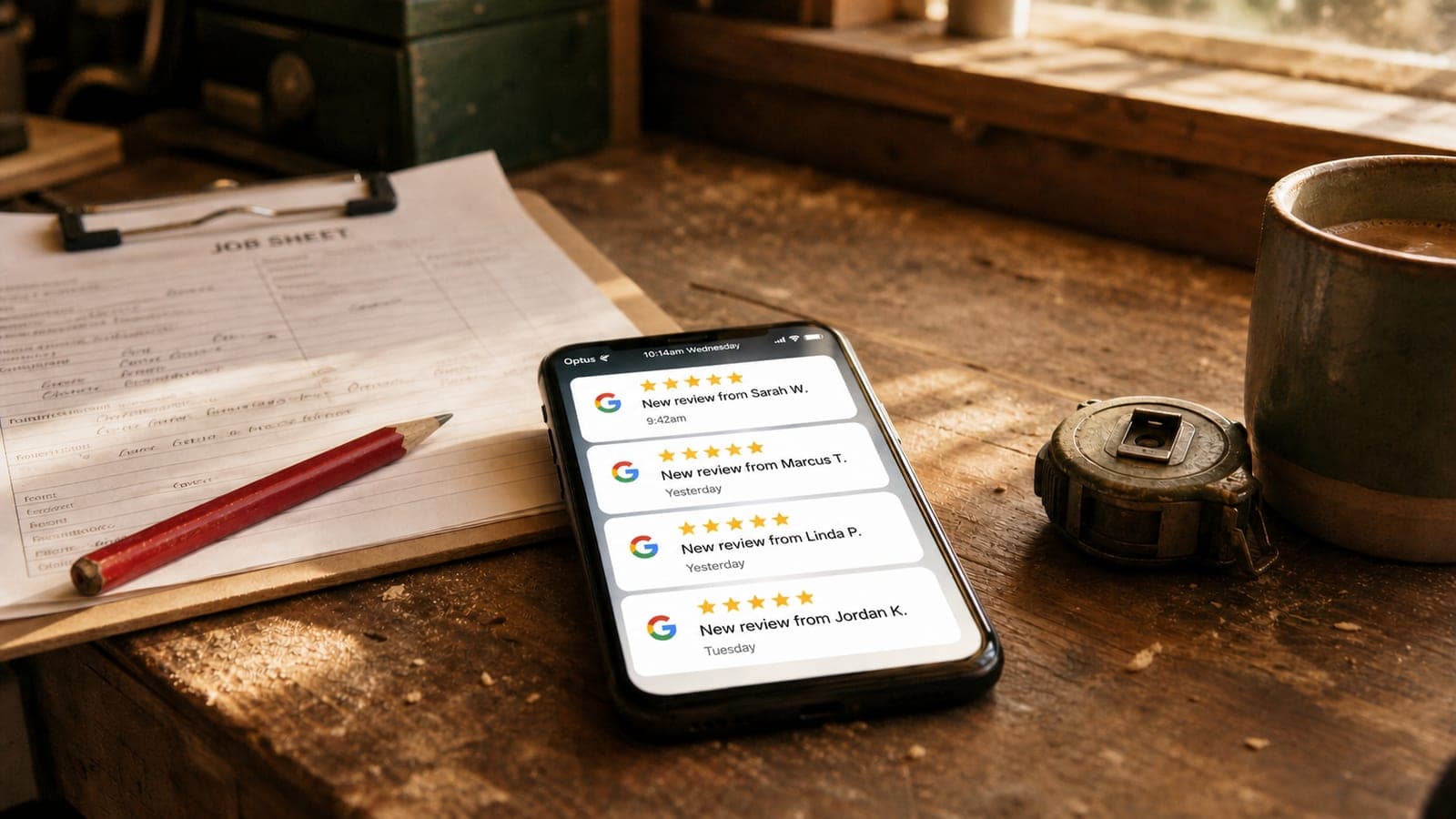
Google reviews are one of the highest-leverage things a service business can build. They’re free. They compound. They tell every future customer “this business is legit” before you say a word.
Yet most plumbers, real estate agents, gym owners, and tradies are either not asking for reviews at all. Or asking the wrong way and occasionally copping a public 1-star they could’ve fixed privately.
The fix isn’t a clever trick. It’s a 5-minute system you set up once.
Why your reviews aren’t growing
Service businesses tend to fall into one of two failure modes.
Mode 1: You don’t ask at all. You assume customers will leave reviews unprompted because they had a great experience. They mostly don’t. Even very happy customers rarely leave a review unless asked directly. They’ve had a good day, they’ve moved on, and writing a Google review takes effort. The customers who DO leave unprompted reviews are usually the unhappy ones. So a business that never asks ends up with a smaller, lower-rated review profile than it deserves.
Mode 2: You ask everyone, the same way. You send a generic “Leave us a review!” SMS to every customer after every job. Most ignore it. Some leave 5-stars. But every now and then, the customer with the bad mood, the dog that escaped during the job, or the bill they’re cranky about leaves a public 1-star. And now you’re firefighting a public review when you could’ve fixed the issue with a phone call.
Most service businesses sit in Mode 1. The ones who try to escape Mode 1 often land in Mode 2.
There’s a third option.
The 5-minute fix: a satisfaction-first system
The fix is one extra step before you ask for the review.
Here’s what it looks like:
- After every completed job, the customer gets a short SMS: “How would you rate the job, 1-5?”
- If they answer 4 or 5 → they get sent the Google review link directly. They’re already happy and primed; conversion to an actual review is high.
- If they answer 1, 2, or 3 → they do not get the public review link. Instead, you get an immediate alert. You ring them. Listen. Often, the issue is something small that can be fixed. And the customer who would’ve given you a 3 because they’d had a bad day often becomes a 5 once you’ve shown you cared enough to call.
This isn’t manipulation. It’s basic customer service. The 1-star reviews that hurt the most are the ones the business never knew about. Where the customer felt unheard and the only outlet was Google. Asking for the score privately first gives you the chance to actually fix the relationship before it goes public.
Why this matters more than you think
A few reasons:
- Local search rankings reward review volume and recency. Google's local ranking signals factor in review count, average rating, and how recently reviews were left. In our experience, businesses with a healthy bank of recent 4–5 star reviews tend to climb the local map pack faster than competitors who rely on a small number of older reviews.
- Recent reviews matter more than old ones. Google’s ranking signals reward a steady drip of fresh 5-stars more than a big batch from 18 months ago. Asking after every job keeps the flow going.
- Negative reviews compound the wrong way. A 1-star review at the top of a profile pushes prospective customers straight to the next listing. And the customer who felt heard becomes the customer who refers a mate, while the one who got brushed off tells everyone they meet for years.
Doing it manually vs systematising
Manual approach: at the end of every job, the technician asks, “If everything was good today, would you mind leaving us a quick Google review?” That works to a degree. Gets some reviews, but is inconsistent and depends on every tech remembering, every time, with the right tone.
Systematised approach: an SMS goes out automatically the day after every completed job. The trigger doesn’t depend on memory. The score routes responses correctly. The owner gets alerted on low scores. Five minutes to set up once, then it runs forever in the background.
The manual approach is better than nothing. The systematised approach is the difference between a business that gets one or two reviews a month and one that gets ten or twelve. And never gets blindsided by a public 1-star they could’ve resolved.
What to actually do with a low score
This is the part most businesses skip. And where the real value lives.
When a customer scores you 1, 2, or 3, your job isn’t to convince them to change their mind. Your job is to listen and understand what went wrong. Most of the time, the problem isn’t the work itself. It’s a small interaction. The tech was rude on the phone. The arrival window was three hours. The invoice came through with an unexpected charge nobody had explained.
A genuine “I’m sorry that happened. Tell me what we got wrong” phone call resolves most of these. Some you’ll fix on the spot. Some you’ll log as feedback that improves how the business runs. A few you’ll never fully resolve, and that’s fine, because at least the customer knows you cared.
The customer who feels heard rarely goes to Google. The customer who’s ignored does, and tells the truth as they remember it.
What changes when you do this
Service businesses that move from no system to a satisfaction-first system tend to see:
- A noticeable, steady increase in monthly review count. Usually a multiple of what they were getting before. The gap between “never asks” and “systematically asks” is enormous.
- A higher average star rating, because the unhappy customers route to a phone call instead of a public review.
- An early-warning system for service issues you didn’t know existed. Patterns show up like “every customer who books on Friday afternoon scores us a 3 because we’re running late”, so you can actually fix the root cause.
- More referrals, because the customers who feel heard send their mates.
How to get this running
The 5-minute part is the customer’s rating SMS. That’s how long it takes to send and respond to. The setup is more involved: the trigger logic (job marked complete in your CRM), the score-based routing (4-5 → Google review link; 1-3 → owner alert), the integration with your Google Business Profile so the review link goes to the right place.
Some service businesses run a version of this called a “Review Gate”. That’s the technical name for the score-routing pattern.
We build it as part of a standard automation pack tuned to your business. Connected to the tools you already use, in 14 days. Explore the automation pack →, or book a 30-min call if you want us to map your specific setup.
Keep reading
How often should you update your website? Six signs yours is overdue
There is no schedule that tells you when a website needs work. There are triggers. Here are the six that actually matter for a service business, and how to tell whether you need a refresh or a rebuild.
Why your website isn't getting enquiries (and the 10-minute self-audit to find out)
If your service business website is getting visits but no enquiries, the leak is almost always one of seven things. Here's a 10-minute self-audit you can run today to find which one.